VisaMadeEasy - AI Student Visa Support
Turned scattered visa requirements into an organized, AI-powered process
Role
Product Designer
Team
1 Designer, 5 Engineers, 1 Product Manager
Tools
Figma
Duration
8 weeks
Background
Students preparing to study abroad face a complex, confusing, and time-consuming application process.
As an international student myself, I have personally experienced the lengthy visa application process with numerous rounds of document submission. These requirements result in wasted time, missed deadlines, and reduced confidence in the application process for many students.

Research
I conducted 3 semi-structured interviews with international students who had recently navigated visa applications to the US, UK, and Australia.
I designed the interviews with two goals:
Capturing lived experiences applying for visas in different countries
Thereby identifying common pain points from a variety of study destinations.
Isolating high-friction tasks
Pinpointing exactly which steps, from document collection to portal submission, cause the most significant emotional distress.
I chose not to interview visa agents or university advisors at this stage. Their perspective would be valuable for v2, but I needed to understand the unfiltered student experience first.
Key findings
The interviews surfaced 4 recurring struggles. We accepted the risk and prioritized speed over completeness.
Solving all four needs would mean building a financial document generator, a policy change tracker, a moderated community, and a behavioral accountability system.
That's a 12-month roadmap, and students needed help now.
Prioritized pain points
rationale
They were the highest anxiety drivers, since students fear of getting rejected for having the wrong info
They are solvable without complex governmental API integrations
Backlogged for later iterations
The problem
How might we provide reliable guidance and structured organization to help students prepare their study abroad applications?
Ideating features
I drafted a feature backlog with my PM, prioritizing those with high impact for users.
Based on the user insights, I defined 3 main objectives for the product:
Clarity
Provide accurate, trustworthy immigration information

Organization
Help students structure and track documents
Timeliness
Keep students on schedule with reminders and progress tracking

Solution
An AI-powered management tool that organizes documents and deadlines in one place, while providing accurate immigration guidance.
For our v1 of the solution, the features would include:
Compared to a traditional information-sharing forum, this product directly addresses information accuracy and organization for users, while keeping the experience simple and intuitive.
Trade-offs
After narrowing our focus, we intentionally left out these factors:
📑
Document preparation would stay manual
users prep them outside the tool, we just guide what to gather
👥
No community features in v1
we'd be the reliable alternative to Facebook groups, not a replacement for them
🎯
Motivation still relies on the user
we'd reduce confusion, but not force compliance
By narrowing scope, we could ship a working product in 3 months instead of unrealistically developing a solution with 10+ different features.
Design system
I built a scalable design system to maintain visual consistency across the product.
By establishing reusable components and clear documentation, I ensured our branding remained cohesive throughout all screens and enabled engineers to build faster with pre-defined, production-ready elements.

Final Design Solution
VisaMadeEasy - An AI-powered management platform that guides students from immigration questions to organized visa application tasks.
Dashboard
Provides quick access to recent chats and upcoming tasks.
Direct access to AI chatbot for timely assistance.
Immigration Support Chatbot
Dedicated flows for guests and registered users.
Answers questions with government-sourced data.
Explains complex requirements in plain language.
→ Make immigration information approachable & reliable.
Application Task & Progress Tracker
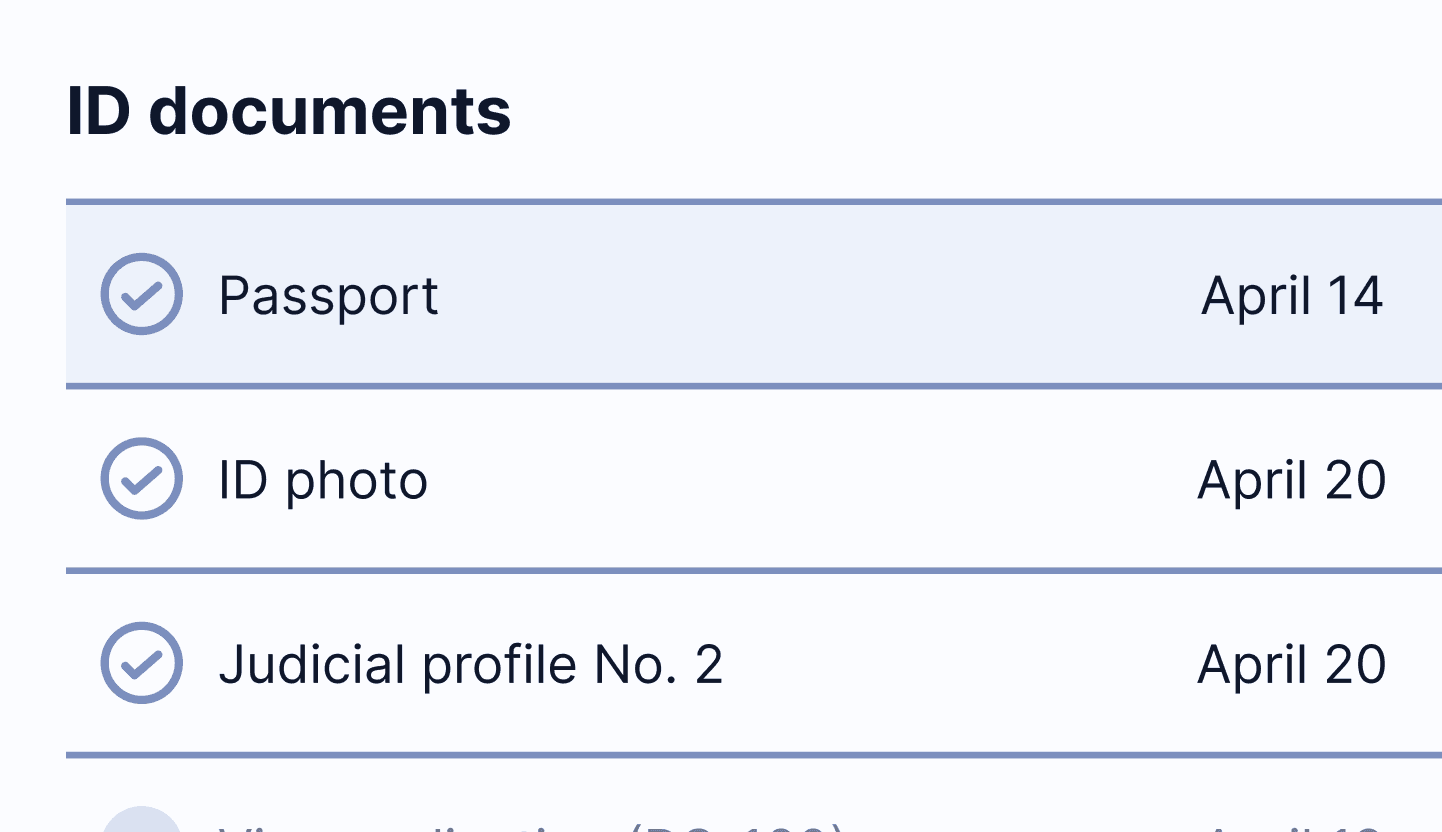
AI assistance generates a categorized list of required documents tailored to visa type.
Reminders tied to submission deadlines.
→ Reduce procrastination and avoid missing deadlines
Allows students to mark completed items and export as a PDF.
→ Keep everything in one place for students, parents, and consultants
Technical constraints
The engineering team couldn’t build the connection between task management and AI agent.

DECISION
We focused on providing separated checklist and guidance first, accepting that organization would be manual at launch.
Reflection & What I'd do differently
Designing for high-stakes administrative hurdles isn't just about organizing data; it’s about managing user anxiety.
Don’t let segmentation become a dead end
I categorized students by destination country, missing edge cases where countries aren't supported. Next time, I'd design a flex-flow that still delivers value for unsupported cases.
Trust should be communicated visually
Visa applications involve deeply sensitive data. For v2, I'd add encryption signifiers and "Verified" states to give users the emotional reassurance they need.
the checklist dilemma
A comprehensive checklist ensures accuracy, but showing 20+ pending tasks at once risks action paralysis. For v2, I'd test progressive disclosure, revealing only the current phase to keep users focused on the next step
While this project began as a challenge to streamline a confusing process, it evolved into a lesson on empathy-driven design.
I learned that for a platform like VisaMadeEasy, success isn't just measured by a completed application: it's measured by the student's confidence throughout the process.